When we talk about digitalization, we generally think of investments in technology, change plans at the level of culture and work practices. Yet there is a very concrete element whose return on investment is guaranteed: the workspace.
Why worry about the workspace
The quality of the workspace has a direct impact on the productivity and efficiency of teams and the company. Even before deploying large digital change plans and significant investments, thinking about and transforming workspaces often proves to be a good first step.
It's not about creating signature spaces à la Google or any other multinational featured in architecture magazines. If you have the means, why not. In this case, make sure the result is not that of a trendy interior designer but of a precise reflection on what you expect from it and the arrangements to be put in place; the architect being responsible for the «orchestration»). If you don't have the means, know that a good space is above all a well-thought-out space. It can be inexpensive and very profitable.
Your workspaces must guarantee two things:
- the pleasure of spending your days there. You should feel «at home» there, but better...
- a quality of space adapted to each type of activity: productivity, concentration, creativity, exchange and socialization, meetings, etc.
In the era of video conferences, it's difficult to be calm in a poorly configured open-plan office. It's difficult to be creative in a dreary office, devoid of the tools to think and be face – literally – to your ideas. Do you have a flipchart? Its physical limits will define those of your creativity: 70×120 cm. And what better way to break the energy than sessions that start 15 minutes late due to shoddy equipment (2000s beamer, incompatible connectors, unfindable Wi-Fi code, etc.).
Societal paradigm shifts
The vision and expectations around working conditions and location, mobility, and flexibility in our society have radically evolved in a few years. These changes must transform our conception of the workspace.
Employees who prefer to work from home are a good indicator that your workspace may not be up to par. Perhaps they sometimes need to accomplish deep work that they cannot accomplish in the office.
Set the spatial conditions for success, as much as the technological or cultural conditions.
The rise of coworking spaces is partly justified because they offer an attractive (professional) lifestyle, an atmosphere that is pleasing and makes one want to work there. Productivity is not just the result of what happens between the chair and the screen. It is also what happens around it.
The workspace: a profitable investment
Why would you spend money to create a quality workspace in the first place? Because creating it is a wise investment decision.
Based on their Workplace Performance Index® methodology, periodic studies by Gensler (in English) reveal a link between workplace quality and the level of innovation employees attribute to their company.
During a client or supplier meeting, or even a recruitment, the environment plays a significant role. It can reflect to your interlocutor your company's ability to reinvent itself. The premises can be representative of work or management methodologies. The candidate can then project themselves, a partner or client can more easily gain confidence and identify that your company's values are very well applied and shared.
How to rethink your work environment?
You will create a productive and efficient workspace only by prioritizing teams and including them as early as possible in the planning process. Don't just present concepts from architects or interior designers.
Here are some ideas to consider for creating a healthier and more productive workspace.
1. To each work its space
A collective workspace, such as an open space, certainly improves collaboration, but also risks reducing productivity by 66% due to distractions caused by conversations and other noise pollution. Provide places where it is possible to isolate oneself to give your employees the necessary time to concentrate on specific tasks in peace.
The atmosphere is an important component of productivity: the better one feels in a work environment, the more efficiently one works there.
Four major criteria contribute to creating a refined atmosphere: the sound environment, lighting, colors, and the general configuration of the space. All these elements should be related to the company's activity. While some tasks require complete silence, others can be stimulated by a light background noise. Similarly, some colors impact certain faculties and others paralyze them, so it is preferable to inquire about colors before painting a wall.
It is not always possible to have separate rooms. You can create and separate spaces within the same room using furniture (bookshelves, movable partitions, isolation booths or «meeting aquariums», ...).
2. From the entrance to the restrooms
The reflection must be global: the workspace does not stop at the offices. Taking into account all premises, even those that are not at your place: home (teleworking) or the coffee shop around the corner, for example. Many people find it more stimulating to think and write a text in a nice cafe rather than at the office.
Ideas and solutions can emerge at any time. And especially anywhere, and very often it's not at your workstation.
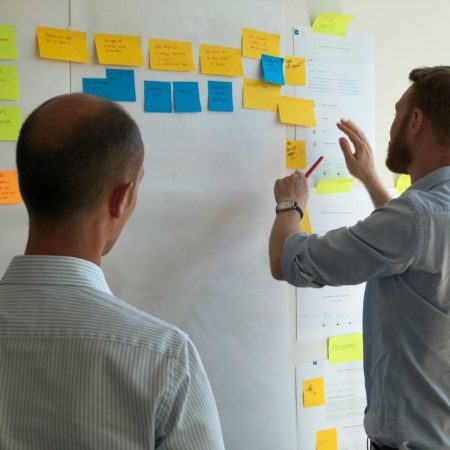
The cafeteria and break areas are particularly important places to equip. How many informal discussions near the coffee machine have generated new ideas, provided a solution, or structured projects. It is necessary to be able to note, draw, diagram without delay:
Great ideas flourish on large surfaces.
Who doesn't constantly run into the restricted dimensions of a flipchart during a brainstorming session or when trying to create a mind map? Every wall can be a whiteboard: ferro-magnetic whiteboard paint or self-adhesive whiteboard rolls cost almost nothing.
Even the toilets should not escape your sagacity. Dirty, dark, noisy? Or do you prefer a pleasant place, where your visit can be made in complete privacy?
We know a company that uses the inside of toilet cubicle doors for its internal communication: the only place where you are guaranteed that everything you put there will be read. You had to think of it!
3. Decoration and informality
Don't be too pragmatic when furnishing your offices. Decorations without a real functional purpose, such as photos or souvenirs, can contribute to a better atmosphere and the well-being of your employees.
Research has also shown that the presence of plants increases productivity. Greenery in the office increases concentration, improves air quality, and reduces stress.
Studies also show that a slight mess proves stimulating for creativity. Have tidy and well-organized spaces while leaving room for a slightly «bohemian» atmosphere.
4. Prerequisites: ergonomics and health
Optimization must necessarily include the concept of ergonomics through office furniture. This is a necessity for the well-being of all individuals at work and for productivity. In addition, it reduces work-related accidents, illnesses, or pains (MSDs).
Quality chairs are necessary. Height-adjustable desks provide real comfort by allowing changes in working positions. This equipment is not that expensive: sit-stand desk from Chf 400 at Ikea.
When renewing computer equipment, don't skimp on the quality of keyboards, mice, and especially screens. But above all, integrate IT, devices, and software into the reflection: it's difficult to enjoy a focus room if the computer cannot be moved from its desk. It's difficult to optimize «dead times» like a train journey or places to think «outside the box» like a café if work tools depend on the local IT network or if device security is not ensured outside the offices.
Conclusion
The quality of the spatial environment is a factor not to be neglected. It has a proven positive impact on productivity, creativity, motivation, health, and the general state of mind of teams.
The digitalization of our society has changed the nature of our activities, and expectations regarding working conditions have evolved significantly. Workspaces are bound to evolve accordingly, otherwise the premises will contribute to the loss of productivity and attractiveness of the company.
Photo credit: Annie Spratt on Unsplash